Warehouse, production, label, stock and asset software that works with the barcode printers, scanners and mobile computers we supply, and the Windows and Android apps we set up for your devices.
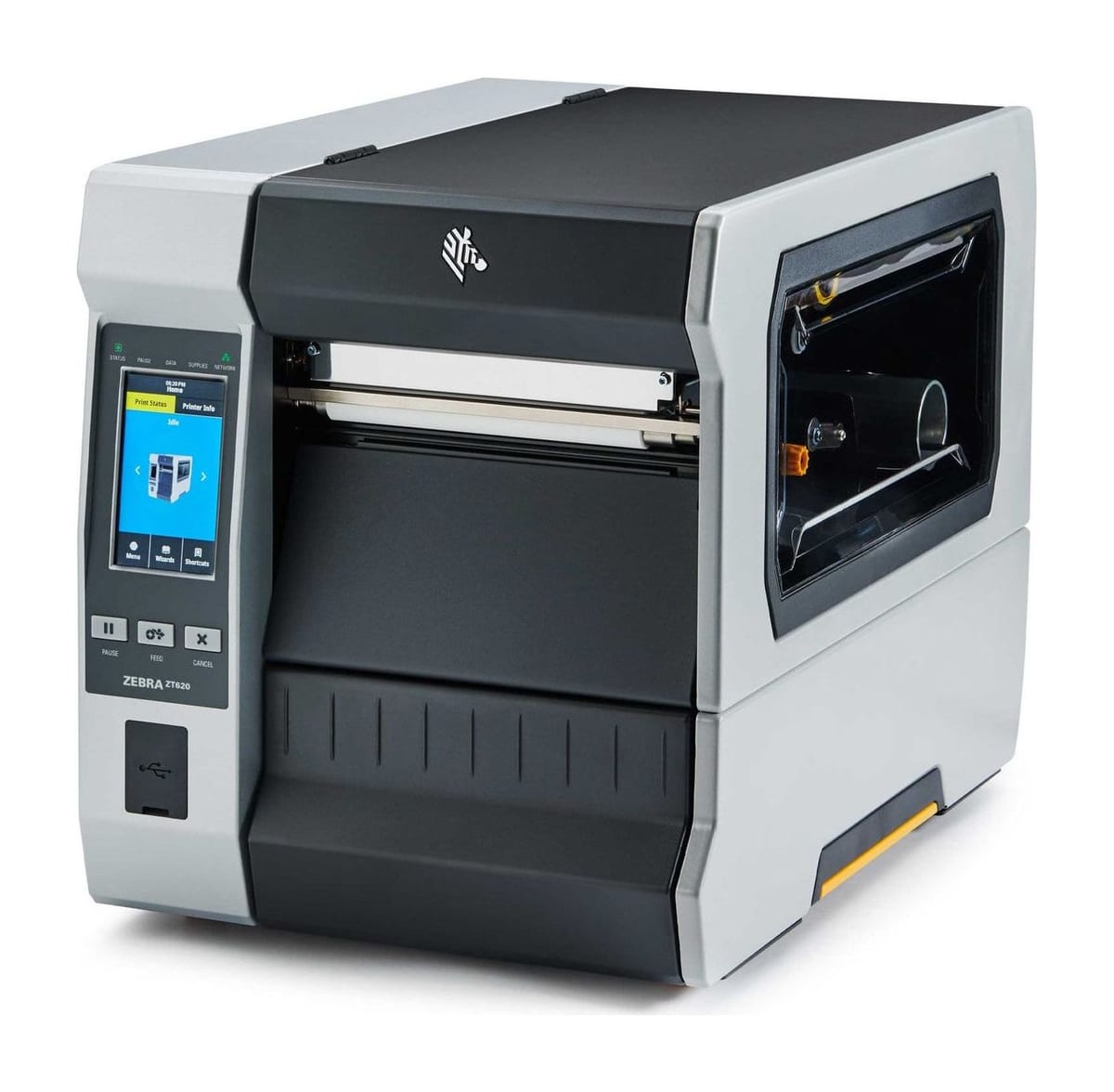
The RFID version of the ZT620: a 6-inch industrial printer that prints and encodes UHF RFID labels and tags up to 168 mm wide, at 203 or 300 dpi, with Gigabit Ethernet and a metal frame.
RFID
UHF EPC Gen 2 V2.1 · ISO/IEC 18000-63 · RAIN RFID
Print width
Up to 168 mm (6.6 in.)
Speed
Up to 305 mm/s (12 ips)
Resolution
203 or 300 dpi
Tag pitch
16 mm or narrower on most RFID inlays
Ports
Gigabit Ethernet · USB 2.0 · RS-232 serial · Bluetooth 4.0
Zebra ZT620 RFID price in India: on written quotation. Share the model, quantity and city; we reply within one working day (Monday to Saturday, 9:30 AM to 6:30 PM).
Covered by the manufacturer's warranty. The warranty period, terms and conditions are as declared by Zebra.
The ZT620 RFID is the 6-inch printer of Zebra's ZT600 Series with the UHF RFID encoder. Zebra Asia Pacific lists it as a model of its own beside the ZT620, and describes it as printing and encoding RFID labels and tags up to 168 mm wide, available in 203 or 300 dpi.
One printer prints the label and encodes the tag
Zebra describes the ZT620 RFID as printing and encoding RFID labels and tags up to 6.6 inches (168 mm) wide. Its RFID spec sheet lists support for tags compatible with UHF EPC Gen 2 V2.1, ISO/IEC 18000-63 and RAIN RFID protocols.
Encoding set up without placement charts
On the ZT620 RFID, Zebra lists Adaptive Encoding Technology, which automatically selects optimum encode settings; its spec sheet says adaptive encoding gives media flexibility and simple RFID calibration, without complex placement guides.
Inlays spaced 16 mm apart or closer
For the ZT620 RFID, Zebra states a tag pitch of 0.6 in./16 mm or narrower on most RFID inlays, and says closer inlays use less label material and need fewer media roll changes.
Serial numbers from the chip, and locked user memory
For serialised tags, the spec sheet lists industry standard, multi-vendor, chip-based serialization and block permalocking of user memory compatible with ATA Spec 2000; RFID job-monitoring tools track performance.
Gigabit Ethernet, with two slots for more
The ZT620 RFID has USB 2.0, RS-232 serial, Gigabit Ethernet and Bluetooth 4.0 as standard, and two open communication slots for a Wi-Fi 6 (802.11ax) card with Bluetooth 5.3, a Wi-Fi 5 (802.11ac) card with Bluetooth 4.2, or a parallel, Ethernet or applicator interface card.
Metal frame and a colour touch display
The ZT620 RFID has a metal frame and a bi-fold metal media cover with a clear window, and weighs 26 kg. A 4.3-inch colour touch display shows status and settings, and media and ribbon load from the side.
These are the points buyers in India ask us about the ZT620 RFID. Mention the ones that apply to you when you request a quote.
Send us the RFID label or inlay you plan to use
Tell us the label size (the ZT620 RFID prints up to 168 mm wide), the inlay and the chip. Zebra lists support for tags compatible with UHF EPC Gen 2 V2.1, ISO/IEC 18000-63 and RAIN RFID protocols, and a pitch of 16 mm or narrower on most RFID inlays. We confirm the printer version for your label in the quotation.
Tell us where the printer will be used
Tell us where the printer will be used and the tags you plan to encode. We confirm the RFID configuration of the unit we quote in the quotation.
Check your label and ribbon widths
Zebra's RFID spec sheet lists media from 51 mm to 178 mm wide in tear or cutter mode and to 171 mm in peel or rewind mode, and ribbon from 51 mm to 174 mm wide. Send us your label width and we confirm the ribbon in the quotation.
Choose the resolution when you order
Zebra lists the ZT620 RFID in 203 and 300 dpi. Its user guide gives print speeds of 2 to 12 ips at 203 dpi and 2 to 8 ips at 300 dpi. Tell us your smallest barcode and text and we confirm the resolution in the quotation.
Specifications
Zebra ZT620 RFID technical specifications
Zebra ZT620 RFID specifications
RFID
Model (as Zebra lists it)
ZT620 RFID (ZT600 Series RFID industrial printers)
Tag protocols
Supports tags compatible with: UHF EPC Gen 2 V2.1, ISO/IEC 18000-63 and RAIN RFID protocols
RFID system
Integrated RFID system is user-upgradeable in the field and available on both 4 in. and 6 in. models
Supports industry standard, multi-vendor, chip-based serialization
User memory
Supports block permalocking of user memory compatible with ATA Spec 2000
Job monitoring
Allows users to track performance with RFID job-monitoring tools
Tag pitch
0.6 in./16 mm or narrower on most RFID inlays
General
Operating System
Link-OS
Print methods
Thermal transfer and direct thermal printing
Construction
Metal frame and bi-fold metal media cover with enlarged clear viewing window; side-loading supplies path; thin film printhead with E3 Element Energy Equalizer
Memory
1 GB RAM memory (32 MB user available DRAM); 2 GB on-board linear Flash memory (512 MB user available on-board Flash)
Display
4.3 in. colour touch display
Programming languages
ZPL and ZPL II; XML-enabled printing; ZBI 2.0 optional
Printing
Resolution
203 dpi/8 dots per mm; 300 dpi/12 dots per mm (optional)
Maximum Print Width
6.6 in./168 mm
Maximum Print Speed
12 ips/305 mm per second
Programmable print speeds
203 dpi: 2 to 12 ips (50.8 to 304.8 mm per second); 300 dpi: 2 to 8 ips (50.8 to 203.2 mm per second); in 1-inch increments (Zebra's ZT610/ZT620 user guide, on Zebra's global documentation site)
Media Sensors
Dual media sensors: transmissive and reflective
Linear Barcodes
Code 11, Code 39, Code 93, Code 128 with subsets A/B/C and UCC Case Codes, ISBT-128, UPC-A, UPC-E, EAN-8, EAN-13, UPC and EAN 2- or 5-digit extensions, Plessey, Postnet, Standard 2-of-5, Industrial 2-of-5, Interleaved 2-of-5, Logmars, MSI, Codabar, Planet Code
16 resident expandable ZPL II bitmap and two resident scalable ZPL fonts; Asian and other international scalable and smooth bitmapped fonts; Unicode for multi-language printing; downloadable objects include graphics, scalable and bitmap fonts, label templates and formats
Media and ribbon
Media Width
2.00 in./51 mm to 7.0 in./178 mm tear/cutter; 2.00 in./51 mm to 6.75 in./171 mm peel/rewind
Maximum Media Roll Size
8.0 in./203 mm O.D. on a 3 in./76 mm I.D. core
Thickness
0.0023 in./0.058 mm to 0.010 in./0.25 mm
Media Types
Continuous, die-cut, notch, black-mark
Ribbon Standard Length
1476 ft./450 m
Ribbon Width
2.00 in./51 mm to 6.85 in./174 mm
Ribbon Core
1.0 in./25.4 mm I.D.
Connectivity
Standard
USB 2.0, RS-232 Serial, Gigabit Ethernet, Bluetooth 4.0; USB host
Connectivity options
Two open communication slots to add internal cards for: dual band 802.11ax Wi-Fi 6 (MIMO) and Bluetooth 5.3; dual band 802.11ac Wi-Fi and Bluetooth 4.2; parallel; Ethernet; applicator interface. IPv6 option is available as external dongle attached to a parallel port
Options and accessories
Media Handling
Rewind: internally rewinds a full roll of printed labels on 3 in. core, or peels and rewinds liner; Cutter: front-mount guillotine cutter and catch tray; 1 in. I.D. core media supply hanger; ink-side in ribbon supply spindle
Keyboard Display Unit
ZKDU keyboard display units for stand-alone printing applications
Physical and environment
Dimensions (closed)
19.88 in. L x 13.44 in. W x 15.58 in. H; 505 mm L x 341.45 mm W x 395.68 mm H
Weight
57.4 lbs/26 kg
Operating Temperatures
Thermal transfer: 40 °F to 104 °F/5 °C to 40 °C; Direct thermal: 32 °F to 104 °F/0 °C to 40 °C
Operating Humidity
20% to 85% non-condensing
Storage/Transportation Temperature
-22 °F to 140 °F/-30 °C to 60 °C
Storage Humidity
20% to 85% non-condensing
Electrical
Auto-detectable (PFC Compliant) 90-265 VAC, 47-63Hz, rated at 250 Watts; ENERGY STAR qualified
Agency Approvals
IEC 60950, EN 55022 Class B, EN 55024, EN 61000-3-2, EN 61000-3-3; cTUVus, CE Marking, FCC-B, ICES-003, VCCI, C-Tick, NOM, S-Mark (Arg), CCC, CU, BSMI, KCC, SABS, IN-Metro
Warranty
Warranty
Covered by the manufacturer's warranty. The warranty period, terms and conditions are as declared by Zebra.
Optional accessories
300 dpi printhead in place of 203 dpi
Dual band 802.11ax Wi-Fi 6 (MIMO) and Bluetooth 5.3 card
Dual band 802.11ac Wi-Fi and Bluetooth 4.2 card
Parallel, Ethernet or applicator interface card; IPv6 external dongle (on a parallel port)
Rewind (full-roll internal rewind, or peel and liner rewind)
Front-mount guillotine cutter and catch tray
1 in. I.D. core media supply hanger
Ink-side in ribbon supply spindle
ZKDU keyboard display unit
Zebra's ZT600 Series RFID spec sheet lists these as options. Ask for them, and for RFID labels and ribbons, in the same quotation.
Specifications from Zebra's published documents, last checked 18 November 2026.
Makers can change specifications without notice.
About our product information
6-inch carton and pallet labels on round-the-clock lines
RFID labels and tags up to 4 inches wide
Labels as small as 3 mm and automated labelling systems
Exploring for a different use?
If your job differs from what the ZT620 RFID is built for, these Zebra models may fit it better:
Buyers who do not need RFID now often look at the
Zebra ZT620 (the standard version; Zebra lists its RFID capability as upgradeable in the field).
Buyers who only print and encode RFID labels up to 104 mm wide, or need 600 dpi, often look at the
Zebra ZT610 RFID (the 4-inch RFID version, 203, 300 or 600 dpi).
Buyers who print labels as small as 3 mm and do not need RFID often look at the
Zebra ZT610 Micro Label (4-inch, 600 dpi only; Zebra notes that RFID and the cutter are not supported on it).
What is the price of the Zebra ZT620 RFID in India?
The ZT620 RFID price depends on the resolution you choose (203 or 300 dpi), the options you add and the quantity. We can quote the labels and ribbon with it. We do not publish prices: share the model, quantity and city, and we send a written quotation with current pricing and
delivery time, replying within one working day.
How is the ZT620 RFID different from the ZT620?
Zebra's Asia Pacific comparison lists RFID capability as 'Yes' for the ZT620 RFID and 'Upgradeable' for the ZT620. Both print up to 168 mm wide at up to 305 mm/s (12 ips), in 203 or 300 dpi. Zebra's RFID spec sheet gives the ZT620 RFID media up to 178 mm wide and ribbon up to 174 mm wide. Tell us if you need RFID now or later and we confirm the version in the quotation.
Which RFID tags does the ZT620 RFID encode?
The ZT620 RFID encodes tags that Zebra's spec sheet lists as compatible with UHF EPC Gen 2 V2.1, ISO/IEC 18000-63 and RAIN RFID protocols, on labels printed up to 168 mm wide. Adaptive Encoding Technology selects the encode settings, and Zebra gives a tag pitch of 16 mm or narrower on most RFID inlays. Send us your label or inlay and we confirm the printer version in the quotation.
ZT620 RFID or ZT610 RFID: which one do we need?
Choose by label width. The ZT620 RFID prints up to 168 mm wide at up to 12 ips, in 203 or 300 dpi. The ZT610 RFID prints up to 104 mm wide at up to 14 ips and adds a 600 dpi option. Both share the same RFID features, Gigabit Ethernet and metal frame in Zebra's spec sheet.
We already run a ZT620. Can it be upgraded to RFID?
Zebra's RFID spec sheet says the integrated RFID system is user-upgradeable in the field, and that it takes five minutes to upgrade the ZT610 and ZT620 to RFID encoding in the field. Tell us your printer's configuration and we confirm the upgrade in the quotation.
What label and ribbon sizes does the ZT620 RFID take?
Zebra's RFID spec sheet lists media 51 mm to 178 mm wide in tear or cutter mode and 51 mm to 171 mm in peel or rewind mode, 0.058 mm to 0.25 mm thick, on rolls up to 203 mm across on a 76 mm core. Ribbons are 450 m long and 51 mm to 174 mm wide on a 25.4 mm core.
Does the ZT620 RFID connect over Wi-Fi?
It connects over Wi-Fi with an option card. USB 2.0, RS-232 serial, Gigabit Ethernet and Bluetooth 4.0 are standard on the ZT620 RFID, and its two open communication slots take Zebra's dual band 802.11ax Wi-Fi 6 card with Bluetooth 5.3, its 802.11ac card with Bluetooth 4.2, or a parallel, Ethernet or applicator interface card.
Can Allmark install the ZT620 RFID and connect it to our software?
Yes. We install the ZT620 RFID at your site, connect it so your ERP, warehouse or billing software prints to it (our own warehouse management system included) and train the people who use it. Tell us the software when you ask for a quote, and we include the setup in the quotation.
Get a written ZT620 RFID quote with labels and setup
Send your label size, how many labels you print a day and the software you print from; we reply with a written quotation.
Since 2014 · 2000+ customers · 75,000+ devices installed · On-site installation & training · Software & ERP integration